Hosting Game Nights
Hand and Foot: rules for the card night table
Hand and Foot is the loud cousin of canasta: two hands per player, four rounds of rising meld requirements, and the game most likely to turn a card night into an institution.
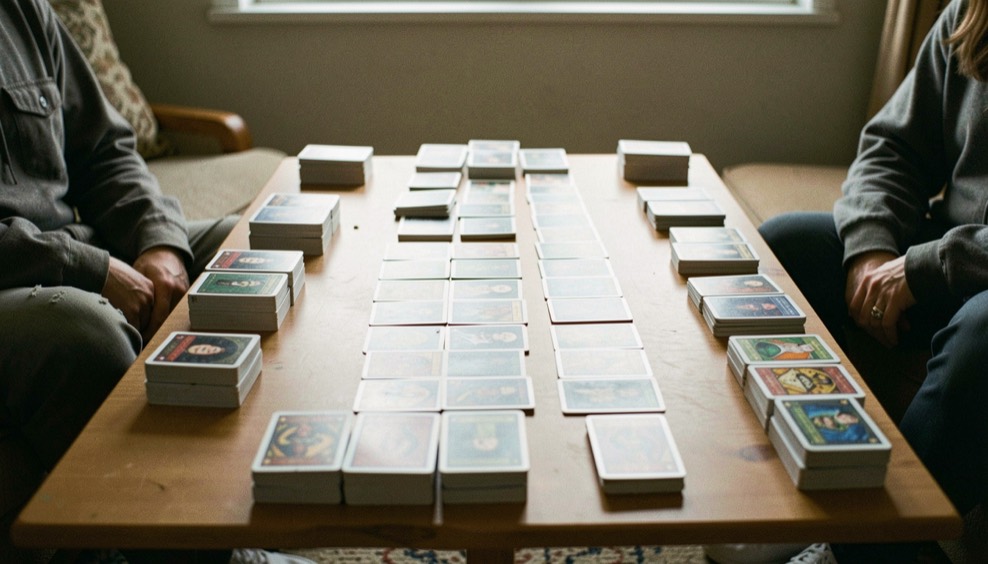
Hand and Foot is the North American relative of canasta that grew too big for its parent's rules: several merged decks, two hands dealt to every player, and four rounds of play with meld requirements that climb until the table strains. It is the game American families play at holiday tables for whole afternoons, and the game card nights adopt when three hours of trick taking wants a change of architecture. The rules vary more from table to table than any other game in the parlor, so this guide gives the common published core and marks every place the house must choose.
The equipment: more decks than dignity
Hand and Foot merges decks: the common household rule is roughly one full deck per player, and the common four player game uses four to five decks including jokers, shuffled together into one giant stock. Two players can play with three or four decks; six players need five or six. Every player is dealt two hands of eleven cards in the widespread version, fifteen and fifteen at tables that want a longer game: the first hand is played first, and the second, the foot, stays face down until the first is exhausted. Picking up the foot at the right moment is half the game's strategy and most of its drama.
The deal and the two piles
Deal two piles per player, the hand and the foot, or let players take two packets of eleven from the common stock at informal tables. The stock sits in the middle with a discard pile beside it, and the discard pile is frozen in the common rules until a player can legally claim it with a natural meld. On your turn you draw two cards from the stock, meld if you can and want to, and discard one card to end the turn. When your hand is exhausted, you pick up your foot and continue; going out means playing every card of both hands with at least one discard at the end.
Melds: clean, dirty and the requirements
A meld is three to seven cards of one rank. A clean meld has no wild cards; a dirty meld carries wild cards, which are jokers and deuces in the common game, and a meld of mixed rank is not a meld at all. The four rounds each demand a minimum meld value before a player may lay down at all, and the requirements are the game's famous staircase: 50 points in the first round, 90 in the second, 120 in the third, 150 in the fourth. The values below are the widely published set; some family books climb higher, and the staircase is the first thing to write on the house rule card.
| Round | Minimum meld to lay down | What changes |
|---|---|---|
| One | 50 points | everyone melds early, stock burns fast |
| Two | 90 points | dirty melds start earning their keep |
| Three | 120 points | sevens and aces carry the table |
| Four | 150 points | the long climb; going out well wins the game |
Card values, red threes and going out
The common published values: jokers fifty points, deuces and aces twenty, eights through kings ten, threes through sevens five, black threes blocked from melds, and red threes worth one hundred bonus points laid out automatically for the player who draws them, or deducted when the round ends in their hand. Melded sets score their point values when laid down, completed books earn bonuses at some tables, and going out scores a bonus that most books set at one hundred. The round ends when one player goes out legally, and the remaining cards in hands and feet are counted against their holders, which is why the foot pile is guarded like a diary.
Common mistakes
Picking up the foot one turn too early and playing the endgame with a hand of dead points. Melding wild cards into the first clean meld, which burns the flex for the 150 point round. Ignoring the discard pile's freeze and building a plan on cards that are not legally claimable. Forgetting the mandatory final discard, the classic going out failure that strands a whole book's worth of points. And letting the same player shuffle all five decks, which is a sentence, not a game preparation.
The institution game
Hand and Foot asks for one thing a trick taking night never needs: an hour of patience at the staircase, repaid by four rounds of rising drama and a score sheet with four fat totals per player. Rule the sheet from the score sheets guide, deal the foot piles deep, and the family table has its winter game. The short games that warm the table up before it sit in the euchre rules and hearts strategy guides, and the evening architecture around it all is the host guide.