Game Rules
Spades rules: bids, nil and bags explained
Spades is the great American partnership bid game: thirteen tricks, spades always trump, and a scoring system that punishes greed with bags as surely as it rewards nerve with nil.
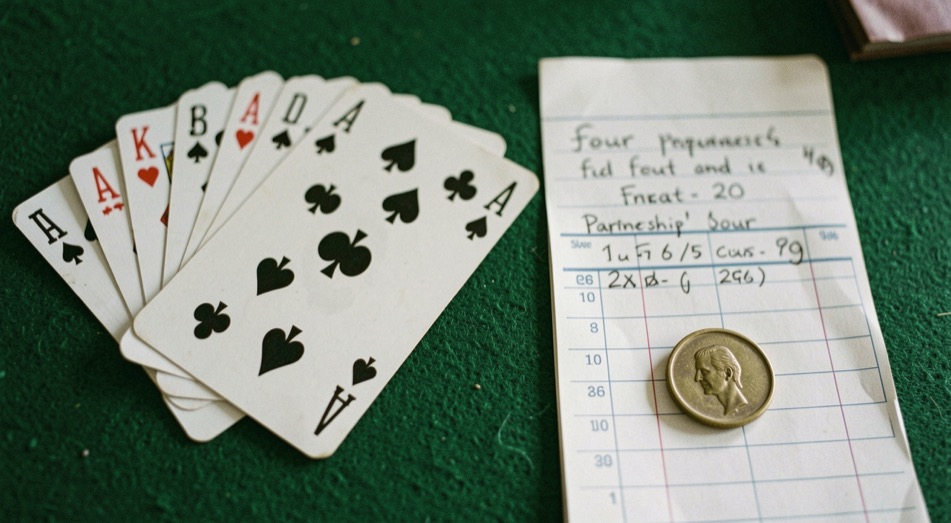
Spades is played by four players in fixed partnerships, partners seated opposite, with the full fifty two card deck. Thirteen cards go to each player, spades are permanently trump, and before a single trick is played each player in turn bids the number of tricks their hand expects to take. The partnership contract, the nil bid and the slow poison of bags make spades the bid game that travels best: every player understands it in one deal and keeps discovering it for years.
The deal
Deal thirteen cards one at a time, clockwise, starting at the dealer's left. There is no draw, no kitty and no dummy in the standard game; what arrives is what plays. The deal rotates each hand. Because spades never change as trump, the whole auction is about quantity: how many of the thirteen tricks the partnership can name and take.
The bidding
Starting at the dealer's left, each player bids a number from one to thirteen, or nil. A nil is a contract to take no tricks at all, and it is scored separately from the partnership's trick contract. In common table play a blind nil may be allowed before looking at the cards, usually only for a partnership that trails by at least one hundred points; the standard published game treats blind nil as an option the table must adopt on purpose. There is no requirement that the four bids sum to any particular number, which is exactly why counting trumps out loud at the table is both legal and decisive.
Playing the hand
The player at the dealer's left leads any card except a spade, because spades may not be led until the suit has been broken, meaning a spade has been played to a trick as a ruff. Follow suit if you can; if you cannot, play anything, and a spade ruff wins unless a bigger spade appears. Highest card of the led suit takes the trick when no spade is played. Thirteen tricks are played, and each trick is gathered by the winner, face down, because the count matters and the order does not.
Nil and blind nil
A nil bidder plays to dodge every trick: refusing with off suit discards, ducking winners, and hoping the partner carries the hand. The nil stands on its own line of the score. If the nil player takes no trick, the partnership earns the nil bonus whether or not the trick contract makes; if the nil player is touched by a single trick, the penalty lands just as independently. Blind nil, where adopted, doubles both outcomes and requires the bid before the cards are seen.
Scoring the hand
Spades scoring is a machine, and the machine is the game. The whole thing fits in one table, which is why tournament scorers love the game.
| Outcome | Score | Notes |
|---|---|---|
| Contract made | 10 x bid, plus 1 per bag | Bags are overtricks beyond the contract |
| Contract failed | minus 10 x bid | Bags taken still count as bags |
| Ten bags accumulated | minus 100 | The bag counter resets after the penalty |
| Nil made | plus 100 | Independent of the partnership contract |
| Nil failed | minus 100 | Tricks taken by a nil also count as bags for the partnership |
| Blind nil, where adopted | plus or minus 200 | Bid before the deal is examined |
| Game | 500 points | Common loss line: minus 200 |
Reading the score between hands
Two habits separate spades tables that win from tables that sulk. First, watch the bag column: a partnership that collects three bags a hand meets the hundred point penalty every fourth deal, which is why cautious overbidding is its own punishment. Second, watch the spread: blind nil exists in table play because a partnership one hundred points behind needs a lever, and the standard game's option is that lever. The arithmetic of bags and the nil decision are argued fully in the spades strategy guide.
Common mistakes
The classic spades errors repeat at every new table. Leading spades early with only three of them, breaking the suit into other people's ruffs. Bidding the hand's aces and ignoring its length, then taking bags on the long suits. Letting the nil player's partner take a fourth unnecessary trick while the nil sits untouched. Forgetting the reset rule and subtracting another hundred for bags already paid for. And shuffling the hands together before the trick count is agreed, which turns a scoring question into an argument with no evidence.
The game in one paragraph
Deal thirteen, bid honestly, keep spades in reserve until the suit breaks, and write every hand on the sheet before the next deal. That is the entire published game. For the counting behind confident bids, read the strategy guide; for the bracket that turns these rules into an evening of championship play, see the tournament formats; and for the sheet itself, the score sheets guide lays out the columns that keep the bags honest.