Tournament Formats
How to run an euchre tournament night
The euchre tournament is the great American card party: partnerships change every round, points pile up on a tally card, and one player goes home the champion by eleven at night.
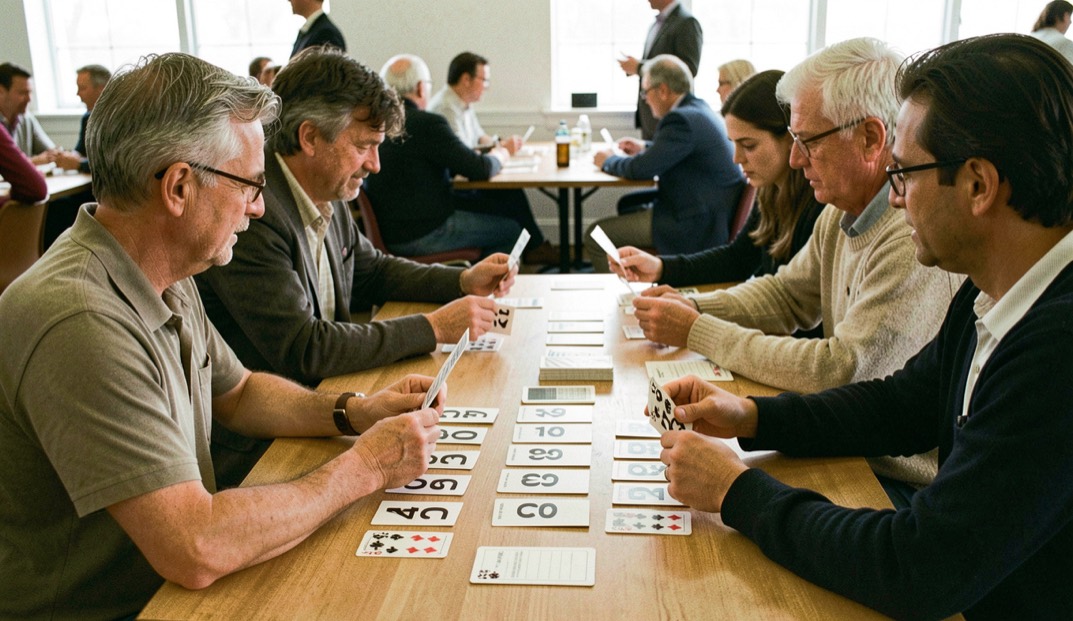
The euchre tournament night is a format older than most of its players remember: eight or more players, tables of four, partnerships that dissolve and reform every round, and a tally card that carries each player's personal score across the whole evening. Nobody is eliminated, everybody keeps playing, and the winner is the player who scored best across all partners and all tables. It is the format that made euchre the social game of the Midwest, and it runs on arithmetic simple enough to chalk on a door.
The numbers before the night
Count players first: the format wants a multiple of four, eight, twelve, sixteen, twenty, because every table seats exactly four and the rotation depends on it. Each round, players draw or are assigned a table and a partner; after the round, they move to a new table with a new partner, and never the same partner twice. The evening runs as many rounds as fit: five rounds of eight hands is the classic shape, six rounds is the ceiling before the room tires. Prizes belong to the highest individual tally, with a booby prize tradition as old as the format itself.
The rotation, written down
The simplest reliable rotation uses numbered tables and a movement chart the host prepares in advance: at each round, players move one table clockwise and switch partners according to a fixed pattern, seat one pairing with seat two, then seat one with seat three, and so on. The published party rotation keeps it simpler still: winners move together one way, losers the other, and partners split after every round. Whatever chart is chosen, print it; a rotation improvised out loud at round three is how tournaments lose their room.
| Round | Hands | Minutes | What moves |
|---|---|---|---|
| 1 | 8 | 30 | draw for table and partner |
| 2 | 8 | 30 | tables rotate clockwise, partners split |
| 3 | 8 | 30 | winners advance one way, losers the other |
| Break | none | 15 | tally cards checked, snacks refreshed |
| 4 to 5 | 8 each | 60 | full rotation, final tallies signed |
Scoring the night: hands, not rounds
The tally card scores hands, not rounds: each player marks one point for every trick their partnership took, with the standard euchre bonuses included, two for a march, four for a lone march, and the euchre penalty scored as zero for the set partnership rather than as a negative. Individual totals travel with the player from table to table, which is why the champion can come from any seat: the format measures the player across eight partners' worth of deals. At the end, tally cards are signed by the last partner at each table, and the host reads the totals aloud.
Running the room
The host's jobs are three: keep the clock, keep the rotation and keep the peace. A visible round timer at the front of the room saves ten arguments an evening. A printed movement chart at each table saves the rest. The peace is kept by one announced rule set: the standard euchre rules guide printed at every seat settles bowers, misdeals and lone hands before they become folklore. Players who must leave early should be scheduled into the bye seat, because an empty chair breaks a table and a broken table breaks the rotation.
Byes, prizes and the odd chair
Real rooms produce real numbers: eleven confirmed players, one cancellation at six, a couple who will not split. The standard answers are all administrative. The bye seat rotates: with a non multiple of four, one player sits each round on a published schedule, everyone sits once before anyone sits twice, and the bye scores the table average for the round so sitting costs nothing but the fun. Prizes follow the format: first, second and the booby, the traditional consolation for the lowest tally, which the record shows is often the most coveted prize in the room. And the host prints one spare tally card per table, because the format runs on paper and paper fails at the worst moment.
Common mistakes
Starting with fifteen players and discovering the problem at round two. Scoring rounds won instead of hands taken, which flattens the format into lottery. Letting the same two strong players partner in rounds one and three by accident, then calling it a coincidence. No timekeeper, so round four ends at midnight. And no printed rules at the seats, which guarantees that the left bower is litigated at least once per table per round.
The party that runs itself
An euchre tournament night is three printed pages and a kitchen timer: the movement chart, the rules, the tally card. Everything else is snacks and noise. For fields that must narrow to a single table, use the bracket formats; for a room that wants the deal itself made fair, the duplicate format is the serious cousin; and for the sheets that keep five rounds of tallies straight, the score sheets guide draws the card that does it.