Tournament Formats
The duplicate format for party card games
Duplicate is the honest format: two tables play the same deals, and the comparison of results, not the shuffle, decides who played the cards better.
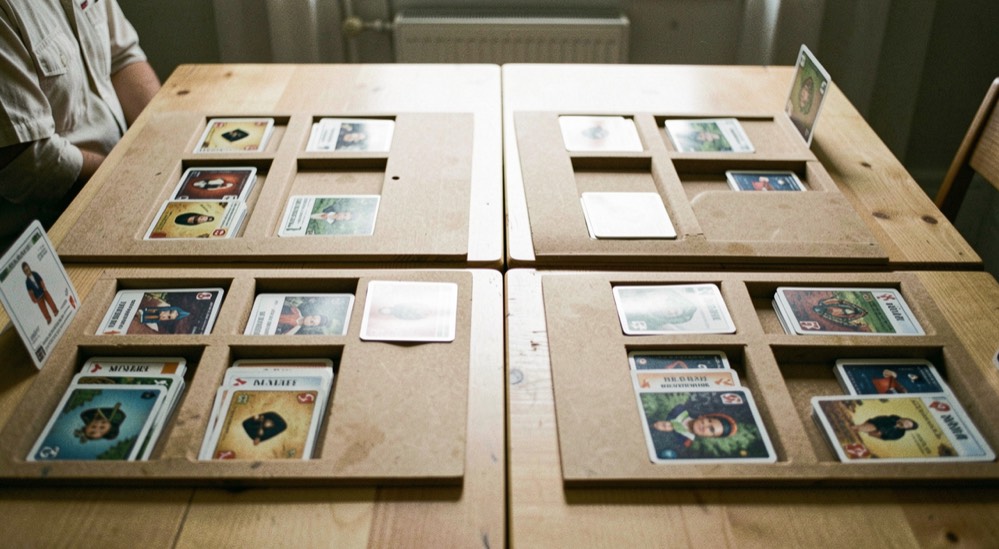
Duplicate play is bridge's great gift to competitive cards, and its idea transfers to every partnership game in the parlor: instead of each table shuffling its own luck, the same deals travel between tables in boards, and each deal is played twice or more by different pairs. Your result on a board is then compared with the results of the pairs who held the same cards, and the score comes from the comparison. The deal stops being an asset, and the game becomes what tournament organizers always wish it were: a test of play.
The equipment: boards and predealt hands
A duplicate board holds four pockets, one per seat, with the cards predealt, sorted by suit and recorded on a travelling sheet. The organizer deals the boards before the session, from a computer deal, a deck duplicated by an assistant, or two packs shuffled by hand with the hands written down as they are sorted. For euchre and spades, the board must also fix the auction data: in euchre, the turned card travels taped to the board; in spades, the board sheet notes the dealer so the bidding order is identical at every table that plays the deal.
The movement: who plays what, where
The movement is the schedule that moves pairs and boards between rounds so that every pair meets a fair spread of the deals. The two standard movements come from bridge and both transplant cleanly. The Mitchell movement keeps North South pairs seated and rotates East West pairs up one table each round while boards move the opposite direction; it suits fields of four tables or more. The Howell movement moves everyone, in a choreography written for the exact number of tables, and it suits small fields because it produces a single winner rather than two directional ones.
| Round | Minutes | Pairs do | Boards do |
|---|---|---|---|
| 1 | 25 | play boards 1 and 2 | rest at each table |
| 2 | 25 | East West move up one table | move down one table |
| 3 | 25 | play the new pairing | repeat the rotation |
| Break | 10 | coffee, and the director checks travellers | rest |
| 4 to 5 | 50 | finish the movement | all boards played by all tables |
Scoring by comparison
After each board, the table writes its result on the travelling sheet. At session end, the scorer compares results board by board: in the bridge style, every pair that did better than another pair on the same board earns a matchpoint, and the session winner is the pair with the most matchpoints across all boards. For euchre and spades, the comparison unit is the hand outcome itself: points scored on the deal, march or set, contract made or failed. Ten tricks made against the same deal scores the same at every table that holds those cards, and the margin of the evening is earned entirely at the table.
Adapting the parlor games
Three details make the classics duplicate ready. Euchre boards travel with the turn card fixed, and the second round of bidding needs a house rule printed on the board card, most sessions score a passed out deal as a neutral board. Spades boards record the dealer and forbid table talk about the unseen kitty, because there is none in the partnership game. Hearts duplicates run best with the pass written into the board instructions, left, right, across, hold, so that every table plays the same hand under the same passing condition.
Boards, numbering and the travelling sheet
Duplicate equipment carries its own discipline. Every board is numbered, and the board records the dealer and the seat order so that two tables playing board seven play literally the same deal, not a near miss. The travelling sheet rides in the board: each table enters its result, the contract and the score, and signs or initials the line. In party duplicates, the board box also carries the fixed data the game needs, the turned card in euchre taped to its pocket, the passing instructions in hearts, because a board that leaves a bidding decision to chance has cancelled nothing. The scorer collects completed travellers, and no comparison starts until every board is home.
Common mistakes
Dealing boards at the venue with players watching, which turns the session into a trust exercise. Letting a board be played twice by the same pair, the classic movement error that the director catches one round too late. Scoring comparisons before all traveller sheets are in. Using regular shuffled decks and calling it duplicate because the room feels serious. And running a Mitchell field of two tables, where the movement collapses and a Howell should have been written.
The format for people who keep score
Duplicate is more equipment and more discipline than a kitchen game, and that is precisely its appeal: it converts the parlor classics into a measurable sport for an afternoon. The bracket format covers fields that narrow instead of compare, the euchre rotation is the party version of the same instinct, and the score sheets guide shows the columns that a session scorer needs before the first traveller comes in.