Card Game History
Pinochle history: binocle crosses the ocean
Pinochle arrived in America as a French and German cousin of bezique and became, within two generations, the loudest game in the American parlor: meld shouted, counted, and written down.
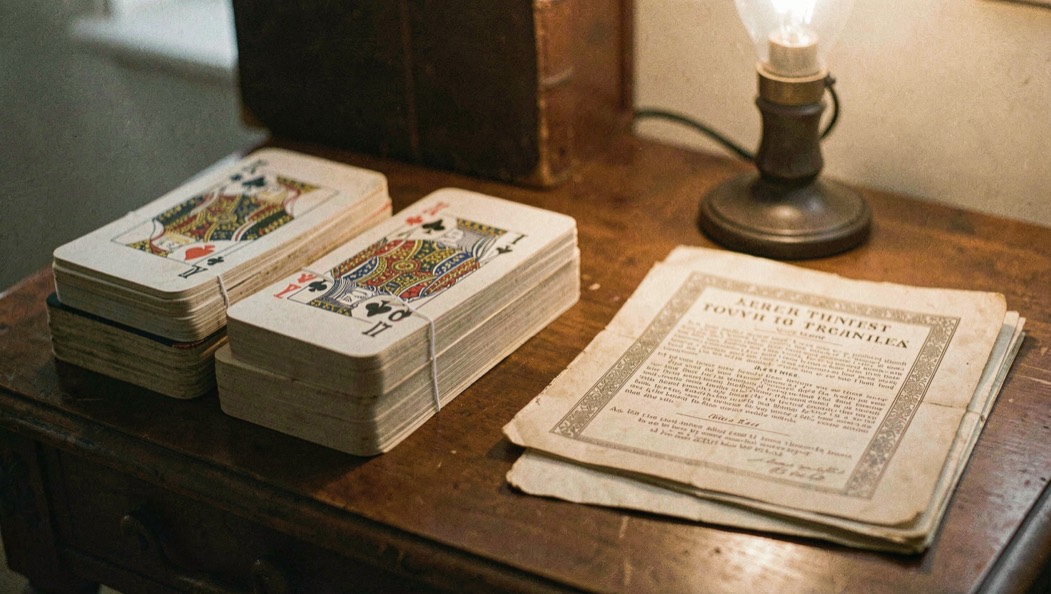
Pinochle's route to America runs through two countries and one card family. The game belongs to the bezique tribe, the marriage and meld games of France and the Rhineland, and it crossed the Atlantic at the end of the nineteenth century with the great waves of German speaking immigration. Within a generation it was an American institution with an American name, played in three languages at once in the parlors of New York, Chicago and San Francisco, and the record of that transformation is unusually easy to read.
The family: bezique, Binokel, binocle
Card historians place pinochle in the bezique family, the games scored by melding marriages and combinations before the tricks are counted. The French branch includes binocle, recorded in France in the nineteenth century; the German branch includes Binokel, played in Swabia with a similar double deck and the same appetite for combinations. The name the Americans adopted is generally traced to the French binocle, filtered through German speech, which is why the game sounds French and feels German at the same table. The famous combination that named the game in America, the jack of diamonds and queen of spades, is the meld called pinochle, a word that eventually swallowed the whole game's name.
The crossing and the boom
Pinochle appears in the American record in the second half of the nineteenth century, spread by German immigrants along the same corridors euchre had traveled decades earlier. Its great boom came in the early twentieth century, when the game became a fixture of the immigrant working class: published accounts describe pinochle tables in union halls, veterans lodges, social clubs and kitchen parlors, with the double deck version growing popular as tables wanted bigger melds and longer auctions. By the 1930s the game was common enough that printed rule books sold in drugstore racks, and the auction partnership form this site describes had become the standard competitive game.
| Period | What the record shows |
|---|---|
| 18th to 19th century | Bezique family flourishes in France; Binokel played in Swabia |
| 19th century | Binocle recorded in France; the family games carry to German America |
| Late 1800s | Pinochle appears in American print among German speaking communities |
| Early 1900s | The boom: union halls, lodges and parlors; auction play spreads |
| 1920s to 1930s | Double deck pinochle spreads; printed rule books reach mass market |
| Postwar | The game settles into its strongholds: veterans clubs, family tables, tournaments |
The variants the record keeps
The printed record of American pinochle is also a record of variants, because every community resized the game to its table. The two handed and three handed games appear in the earliest American rule books alongside the partnership form. Auction play, where the bidding decides everything, grew with the clubs that wanted a competitive rather than a cooperative game. The double deck version spread in the early twentieth century for tables that wanted bigger melds and longer auctions, and it is the form most tournament pinochle plays today. Gambling variants existed too and are documented, but the published heart of the game's history is the family and club table, where the stakes were quarters and the arguments were free.
What the name carries
The word itself is the best fossil the game owns. French binocle descends in the dictionaries from the Latin for two eyes, a word for spectacles that the card table borrowed, and the German Binokel kept the spelling while the American tongue wore it down to pinochle. The meld that gave the American game its name, the jack of diamonds with the queen of spades, is one line in the older games' scoring books, which means the American name keeps a detail of the parent game inside it. The record is not equally clear about every step of that borrowing, and honest histories mark the blur; what is certain is the direction of travel, from the Rhine borderlands into American speech, where the word now means the whole game and has for a century.
The union hall game
The published story of American pinochle is inseparable from the working men's and women's clubs that kept it: the game demanded a table, four chairs, two decks and time, and the institutions that had all four were the union halls and lodges. The same arithmetic the game teaches, counting meld before spending tricks, made it a gambler's game only in the way that chess is one: the record describes championship play in clubs and veterans organizations through the whole twentieth century, and the tournament pinochle of today descends directly from that club play.
Common mistakes about the history
The recurring errors are three. Calling pinochle simply a French game, when the American game is the child of the French German borderlands and grew up in German America. Dating the double deck game first, when the printed record shows single deck partnership play as the norm before the bigger game spread. And confusing the meld that named the game with the game itself: pinochle the combination is one line in the meld book, and pinochle the game is the whole ledger built around it.
The ledger the immigrants wrote
Pinochle's history explains its rules the way euchre's history explains its bowers: the doubled deck is the Rhine doubled deck, the marriage melds are bezique's inheritance, and the auction is the American addition that made the game a sport of nerve. The full modern rules are in the pinochle rules guide, the numbers are collected in the pinochle scoring guide, and the sheet that carries the whole ledger is drawn in the score sheets guide.