Card Game History
Euchre history: from the Rhine to the Midwest
Euchre is an immigrant game whose route can be traced in the printed record: from the Upper Rhine, through the Pennsylvania German country, up the Ohio and into every parlor in the Midwest.
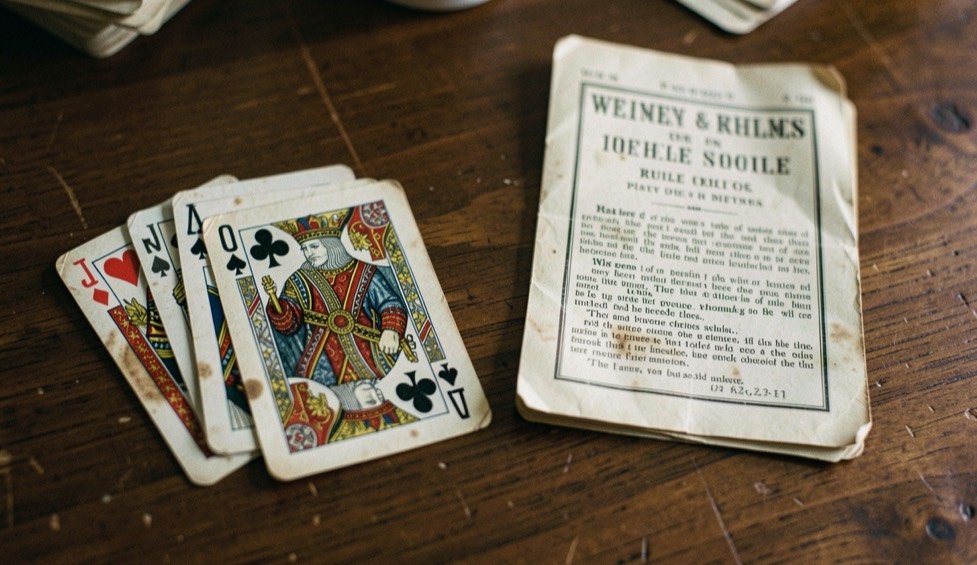
Few American card games carry their passport as openly as euchre. The name, the bowers and the vocabulary of the game all point across the Atlantic, and the printed record of the nineteenth century lets the route be traced with unusual confidence. This history keeps to what is published: where the game came from, who carried it, how it conquered a continent's card tables, and why every deck of cards in the world owes euchre a joker.
The German roots: Juckerspiel
The standard account, repeated across the card historical literature, derives euchre from the family of trick taking games played along the Upper Rhine in the eighteenth century, closest of all to Juckerspiel, recorded in Alsace in the eighteenth century and played with the same stripped deck, the same two jacks raised above their suits, and the same partnership structure. The names survive the crossing almost intact: the German Bauer, meaning farmer and used for the jack, became the American bower, and the game's calls of order up carry the rhythm of the German table talk. The dialect of the game, in other words, was set before it ever boarded a ship.
The crossing: Pennsylvania Dutch country
The game reached British North America with German speaking immigrants, the people whose Deutsch became the American Dutch, and Pennsylvania German country is where euchre first appears in the American record. From there the game traveled with the settlement of the Ohio valley in the early nineteenth century, and it was in the river towns and newly plotted counties of Ohio, Indiana and Illinois that euchre became the American game. Early references in American print grow frequent through the 1840s and 1850s, and by the Civil War years euchre was widely described as the standard American partnership game, the game soldiers played in camp and carried home.
| Period | What the record shows |
|---|---|
| 18th century | Juckerspiel and cousins played along the Upper Rhine and in Alsace |
| Early 1800s | The game crosses with German immigrants into Pennsylvania German country |
| 1830s to 1850s | Spread up the Ohio valley; American print references multiply |
| 1860s | Euchre at the height of its first vogue; the joker enters American decks |
| 1870s to 1880s | Euchre parties and clubs nationwide; rule books and printed guides appear |
| 1890s onward | Bridge and whist fashions push euchre into its lasting Midwest heartland |
The joker: euchre's gift to every deck
The most famous fact in euchre's history is the one printed on every pack of cards sold today. The joker was devised in the United States during the euchre craze of the mid nineteenth century, as an extra best bower for the game, and card historians generally credit Samuel Hart's Philadelphia firm with printing the first decks carrying the extra card in the 1860s. The card outlived its reason for existing: euchre kept its twenty four card deck, and the joker rode along in every fifty two card deck since, an orphan of the game that invented it.
The name and the printed word
The etymology the literature generally accepts derives euchre and Juckerspiel from a common German root, and marks anything beyond that as uncertain; the game's own name is older than its American spelling, which settled early and settled everywhere at once, a sign of how quickly the game spread through print as well as play. American print took the game up in earnest in the middle of the nineteenth century: encyclopedias described it, newspaper columns taught it to readers who had not met it at home, and cheap rule pamphlets carried the standard game into communities that would otherwise have kept regional versions. That pamphlet culture is one reason euchre's rules are so uniform across the Midwest today, and why this site can write a single standard game at all.
Euchre parties: the social format
The euchre party, the rotation of partners across tables with tally cards and small prizes, is a documented institution of late nineteenth century American social life, reported in newspapers from Chicago to small Ohio towns as a standard evening's entertainment. The format this site describes in the euchre tournament guide is, in other words, the historical format: the game and the party grew up together, and the tally card is nearly as old as the bowers.
Common mistakes about the history
Three errors recur. Calling euchre's origin French, a claim that circulates widely but is not what the vocabulary or the printed record supports; the game is German in speech and structure, whatever routes individual players took. Dating the joker before the game that required it, when the published sequence runs the other way. And treating the Pennsylvania Dutch as Dutch, when the word is the American pronunciation of Deutsch, the German language the game's own terms come from.
Why the story matters at the table
Every quirk of euchre's rules is a fossil of this route: the stripped deck is the Rhine deck, the bowers are the German jacks, the lone hand is the Rhine game's solo play, and the joker in your poker deck is the game's birth certificate. The full rules those fossils make up are in the euchre rules guide, the strategy the game rewards is in the euchre strategy guide, and the party format that carried it across a continent is the euchre tournament night.