Strategy Guides
Euchre strategy: order up, or pass?
Euchre strategy is a short list of counts performed quickly: how many trumps are out, who can still have the left bower, and whether this hand pays to play alone.
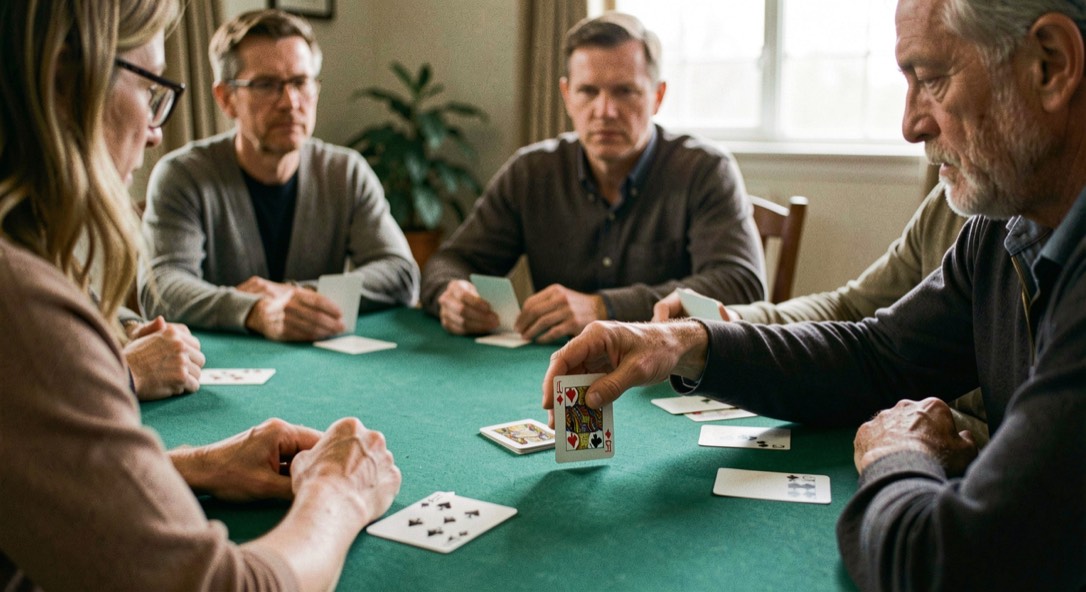
Good euchre is not luck management; it is three counts performed before the first card is led. How many trumps do I hold against the eleven that are out? Do I hold a bower or the ace behind the bower? Can my partner plausibly carry one trick if I feed him one? Every decision in the game, from ordering up to the last card of the last trick, falls out of those counts, and the guides that pretend otherwise are selling folklore.
The first decision: ordering up the dealer
The classic standard says three trump is a hand to act on, but the composition of the three decides everything. Three trumps with both bowers or a bower and the ace is a make from any seat. Three small trumps with no aces is a pass from the first two seats and a coin flip in the third. The strongest holding in the game is the right bower plus one small trump plus an off suit ace: that hand makes trump from anywhere and usually marches. The weakest make is two small trumps and hope, and hope loses exactly as often as probability says it should.
Seat position changes the mathematics
First seat, at the dealer's left, orders up with strength alone because two opponents still speak after him. Second seat should be stiffer: his partner has already passed, so he is playing his own cards alone. Third seat, with the partner who passed, orders up on anything that can take one trick, because the partner passed weakness and the ordering is really a partnership bid. The dealer himself, holding the turned card in hand after picking it up, counts the discard as the sixth trump or the guard of an off suit ace and discards accordingly.
| Your hand | First and second seat | Third seat |
|---|---|---|
| Right bower plus two trump | Make, and consider alone | Make |
| Right bower, one trump, off suit ace | Make | Make |
| Three trump, none higher than queen | Pass without an ace | Make if any trick in hand |
| Left bower plus two small trump | Make | Make |
| Two small trump, no honors | Pass | Pass unless holding two aces |
Going alone: the arithmetic of four points
A lone hand wins four for a march instead of two, and loses nothing extra when it fails to march, which is why the temptation never leaves the table. The standard test is ruthless: go alone with three trump including the right bower, or with five certain tricks in sight, and never alone with a hand that needs the partner to survive. The partner's discards also matter: she must sit out, so any lone call throws away whatever her hand carried. Tournament players go alone less than kitchen players remember; the two point make is the bread of euchre, and the four point lone hand is the occasional feast.
Leads and follow ups
The maker leads the right bower at the first opportunity; the lead pulls trumps and protects the left bower from being endplayed later. The opposite partnership leads aces of off suits early, while they are still bosses, and never leads small trumps as defenders unless the score says desperation. Partners signal with tricks rather than with cards: feeding a trick to a partner who ordered trump is not charity, it is the contract working. And the player who holds the left bower behind an uncontested right bower counts it as a winner only if the right bower appears; otherwise it is the second highest card alive in the deck.
Defending the lone hand
When an opponent declares alone, the defense has one written job: take one trick, and the lone caller scores nothing but the single point. The standard plan is to lead the ace of the longest side suit immediately, before the lone hand can ruff it, and for every defender to hold a guarded king rather than an unguarded one. The partner of the lone caller sits out, so every trick the defense takes comes out of the lone hand itself. Tournament players defend lone calls calmly for exactly this reason: the odds favor one trick more often than the lone caller's table talk suggests.
Common mistakes
The mistakes repeat so reliably they deserve their own list. Ordering up on two small trumps from first seat, then wondering where the march went. Going alone with three trumps that include no bower and losing the march the partnership would have made. As a defender, leading trump into the maker's boss cards instead of racing aces. Forgetting to count: four trumps have been played, you hold two, so exactly five remain and three of them may sit in one opponent's hand. And discarding an off suit ace to keep four trump, when the third trump was never going to take a trick anyway.
The count is the strategy
Euchre rewards the table that counts and forgives the table that feels. Order up with three real trumps or a bower, sit tight otherwise, feed your partner when he named the suit, lead the right bower once you hold it, and treat the lone hand as a rare, arithmetic occasion. The rules behind every term above are laid out in the euchre rules guide, the rotation that turns these habits into a tournament belongs to the euchre tournament night guide, and the game's own crossing from Germany is told in the euchre history.